
Forensics: why a crypto price moved
When a coin drops or jumps, the headline explanation usually arrives after the move. A Forensics report starts from the market data instead: it times the move to the minute, works out what happened first and what followed, and says plainly which parts of the story the evidence establishes and which it does not.
In short
A Forensics report reads the last 24 hours of a coin — its perpetual market on Hyperliquid, its own trading pools and its market price across exchanges, wherever it has them — picks out the move that matters, and explains it in thirteen fixed parts — from a plain answer at the top to the clock and coverage behind every figure at the bottom. Each claim is either measured, consistent with the evidence, or not established, and the report says which.
What a report works out
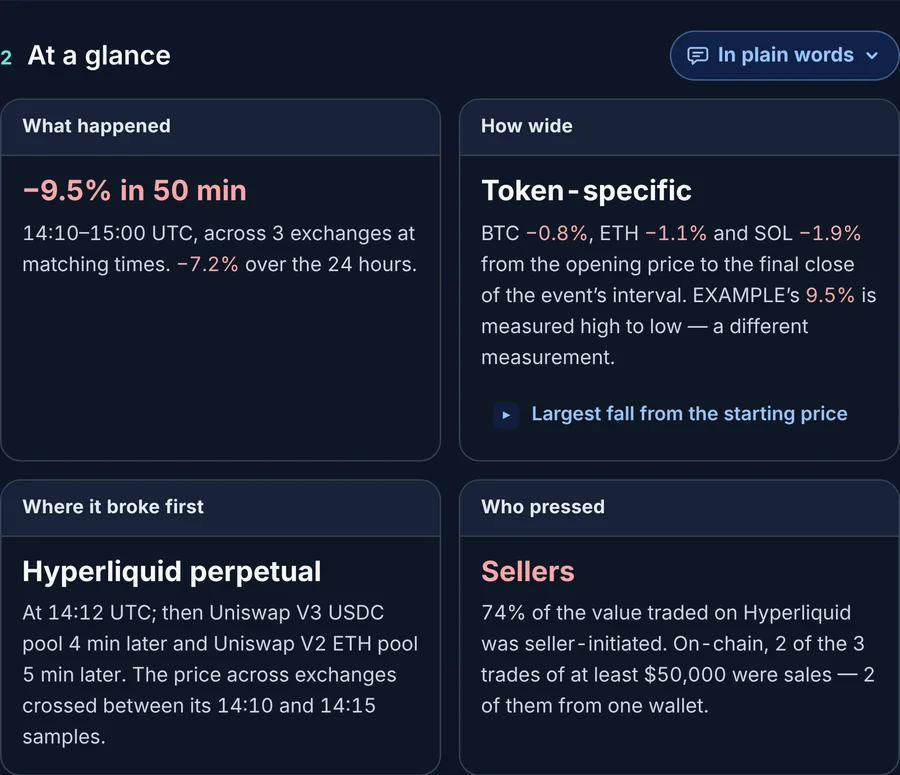
- The move itself. Which move in the 24 hours is being explained, from which bar to which bar, and how large it was — kept apart from the coin’s whole-day change, because the two are different numbers.
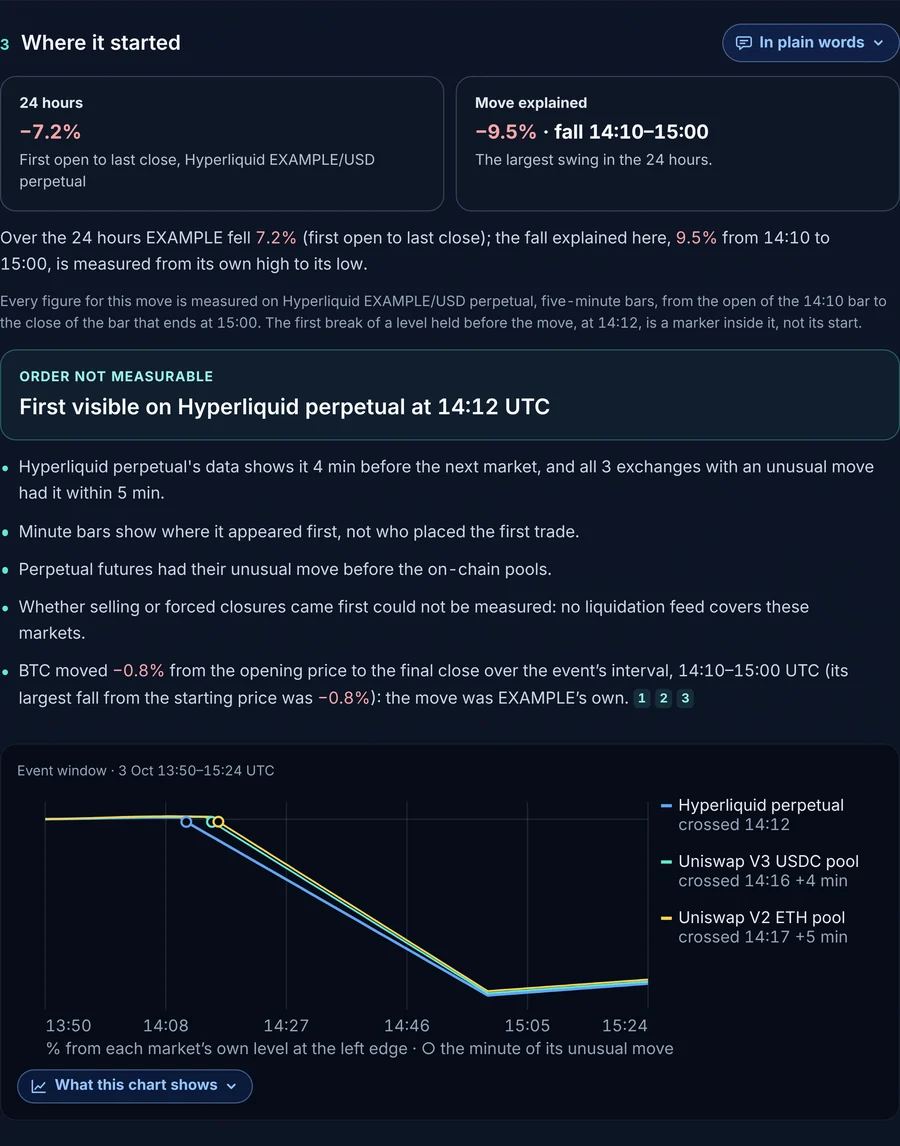
- Where it started. Which markets broke first, on one-minute bars, and whether the first break can be pinned to one exchange or happened on several within the same minute or two.
- Who pressed the trades. Whether buyers or sellers started most of the value traded during the move, the largest traders on the pressing side, and the coin’s largest trades in its own pools — by address, never by name.
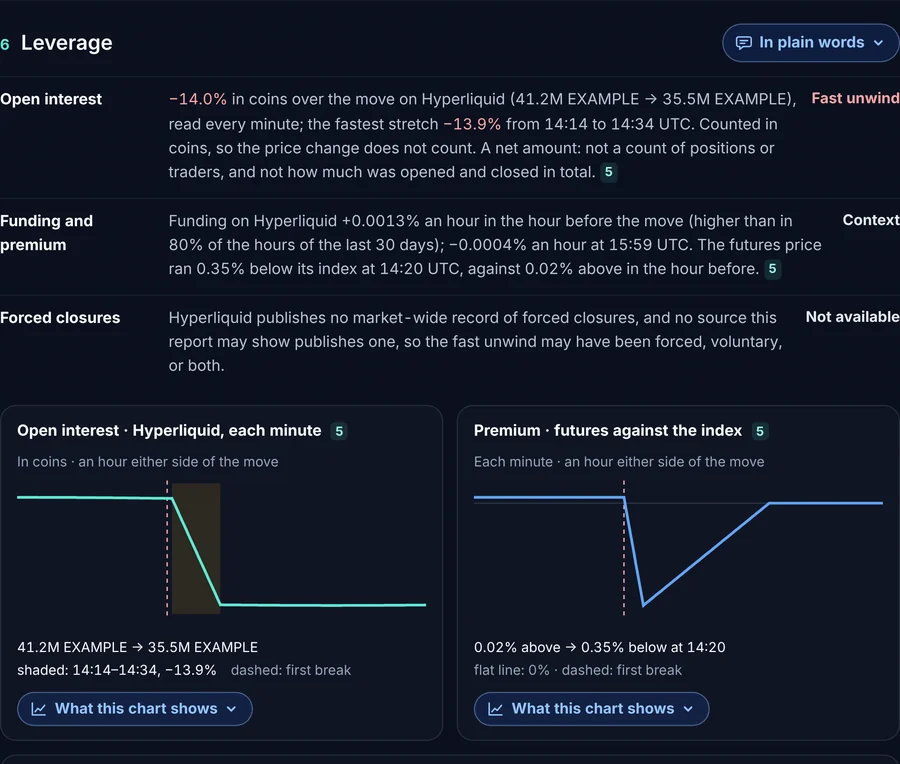
- Leverage. How open interest changed across the move, counted in coins so a price change cannot make it look smaller, how fast it changed, and where funding stood against its own last thirty days.
- Liquidity. Where our server records the order book, whether it thinned within 1% of the price before the move broke; and, for each exchange, how much it takes to move the price 2% when the report is read.
- The market around it. Whether Bitcoin, Ether and Solana moved the same way over the same interval, or whether the move was the coin’s own.
- News and timing. Which stories were published about the coin, and whether each appeared before the move started, during it or after it — a recap written after the fall is never presented as its cause.
Evidence, not a story
A report never says who sold or why. It says what the trading data shows — for example, that seller-initiated trades made up most of the volume, or that open interest fell by a stated amount — and what that is consistent with. When the evidence cannot separate two explanations, it names both and says what would tell them apart.
Which reports you can read
- Standing reports on the 5 largest coins refresh at 00:15, 08:15, 16:15 UTC every day, and again after a sharp move. The Bitcoin and Ether reports are open to everyone; the other three need a free account.
- Your own reports on any listed coin use credits: 1 credit for one coin, 2 credits for the whole market, 2 credits to compare up to 4 coins. Pro includes 3 credits a month.
- A run that fails uses nothing. A delivered report uses its credits even when it cannot establish a cause — saying so is part of the answer.
- Your reports are yours. A report you run is not published or shared; only you can open it.
Read today’s Bitcoin report
The Bitcoin and Ether reports need no account.
Try CycleLens
The dashboard needs no account. Pro can be tried free for 7 days, with no card.